
Research
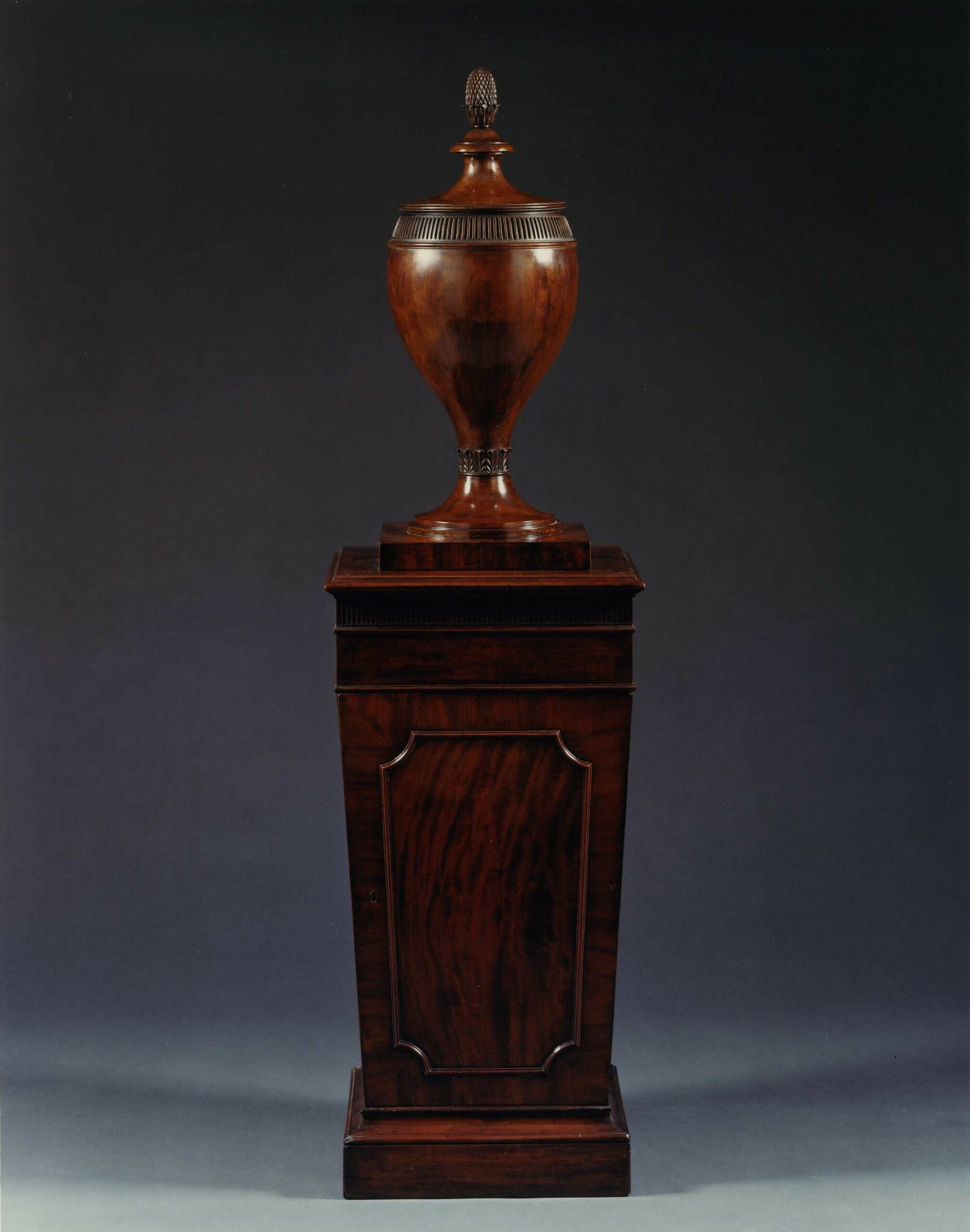
Of mahogany. Each with a pinecone finial surmounting a shaped and molded lid, the lid set on an unusually shaped vase with a fluted frieze and acanthus leaf collar, the urn raised on a tapering paneled base with molded edge above a fluted frieze, the frieze above a single drawer, the drawer to one pedestal fitted with lidded containers for tea, the drawer to the other pedestal lined with lead, each pedestal set on a plain plinth with a molded edge.
Provenance:
Formerly in the collection of Sir James Walker
Sold by Sotheby’s London, 4 November 1927, Lot 141, Property of the Late Sir James Walker, C.I.E.
Included in M. Harris and Son, A Catalogue and Index of English Furniture, Part III, London (1932), p. 393
In the 18th century, side tables employed in the dining room were not yet themselves equipped with storage spaces, but were used in conjunction with separate pedestals. Such sideboard-pedestals, topped with urns or vases, appeared in dining rooms circa 1760 and provided additional utility and storage. Plate warmers and cellarettes could be found in the bases, along with iron stands and heaters, while the urns were used for holding iced water, or water for rinsing the silver. It was customary to wash glasses and cutlery during dinner even into the early 19th century, as evidenced by mention of the practice in George Smith’s Household Furniture (1808).
Full research report available on request.