
Research
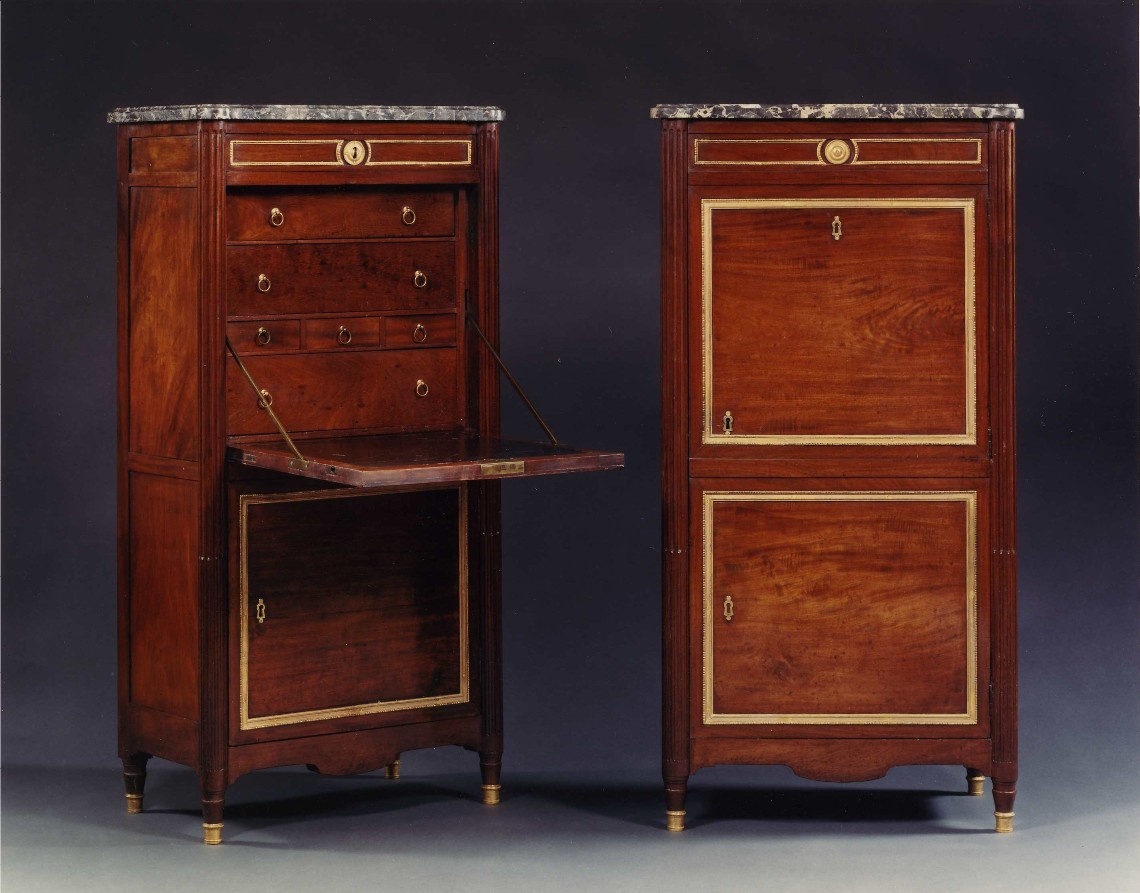
Of mahogany and gilt-bronze mounts. Each with a rectangular marble top with molded upper edge and bosses to the corner above a paneled frieze centered by a molded gilt roundel with cable molding to the edge flanked by panels edged with gilt bead and reel molding, the frieze above two rectangular panels with molded gilt edging and bead and reel molding, the front flanked by two circular tapering fluted and stop fluted uprights, the sides with plain panels, the whole raised on four circular tapering legs terminating in gilt caps. The one with the frieze opening as a single drawer, the upper panel opening as a fall front with inset leather top to an interior set with drawers with ring handles, the lower section opening as a door to a plain interior, the other comprising a safe, with the front opening as a single door to an interior shelved in the upper section and with a compartment below secured by a steel clamp concealing an escutcheon. Gilding refreshed in places. One top possibly not original, but very old.
Marks:
Stamped to the rear:
J CANABAS
Provenance:
Parisian Collection
Beaussant Lefèvre, April 25, 2003, Lot 143
The superb quality and simplicity of these secretaires mark them out as the work of Joseph Canabas (1712 – 1797), the celebrated Parisien ébéniste whose stamp they bear. Canabas was able to work in more than one mode, including Le Style Anglaise and Le Gôut Grec, from which the restrained classical lines of the present cabinets draw their inspiration. Producing pieces which presaged the austerity of design of the Directoire period, his output can sometimes be compared to that of the other great late-Louis XVI ébénistes Adam Weisweiler (1744 – 1820) and Guillaume Benneman (d.1811).
The geometric simplicity of the present cabinets reveals Canabas to have been one of the pioneers of a radical aesthetic which came to prominence in France during the revolutionary era of the 1790s. This style, which was encapsulated in the designs of avant-garde architects such as Claude-Nicholas Ledoux (1736 – 1806) and Etienne-Louis Boulée (1728-99), offered a pared down classicism which anticipated the sparse minimalism of twentieth-century design.
Full research report available on request.