
Research
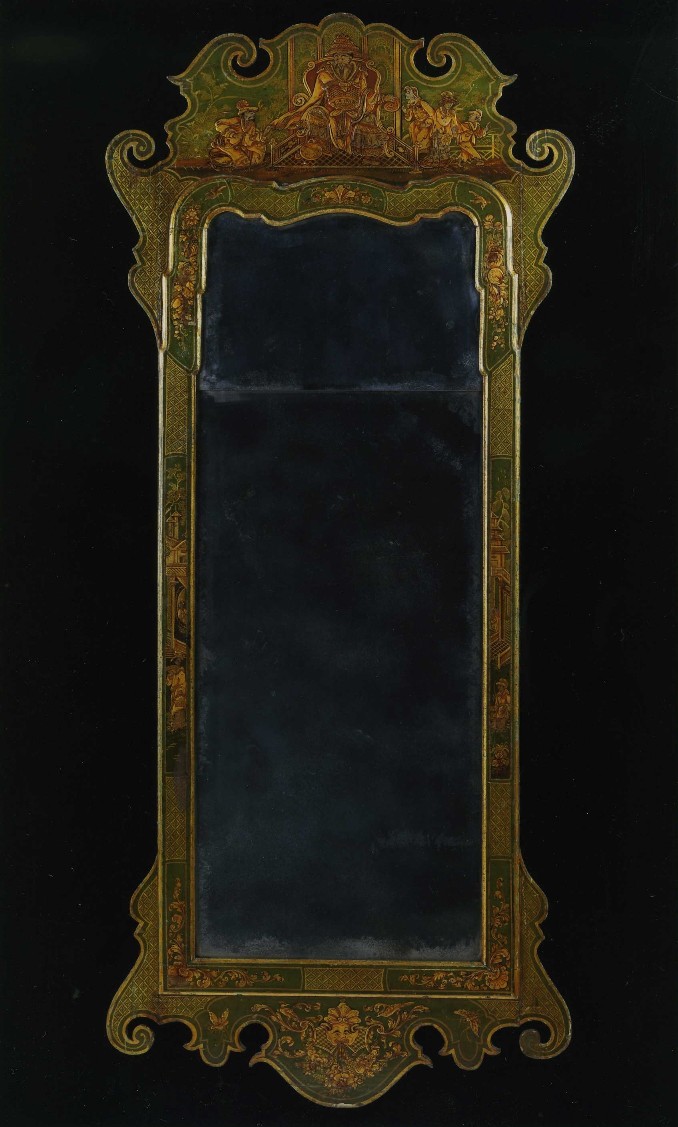
Of green lacquer. The shaped and scrolling cresting filled with image of a monumental seated oriental figure above a later rectangular mirror plate shaped to the top, the frame with scenes of foliage and oriental life interspersed with diaper pattern borders, with shaped and scrolling apron below centered with a mask decoration.
The distinctive decoration of this important mirror is closely related to the known works of the celebrated master of English lacquer furniture, Giles Grendey (1693-1780).
The mirror is a rare example of the highly unusual olive green colour of lacquer. Although red was the most popular ground colour for English craftsmen producing Japanned furniture, Stalker and Parker’s Treatise of Japanning and Varnishing reveals the wide range of colours which could be employed. First published in 1688 and regarded as the primary source of instruction in the art of Japanning, the Treatise listed eight possible ground colours for lacquer furniture, including Green, made using what was called ‘distilled Verdegreas’.1 In the present mirror the green colour of the ground is complemented by the use of delicate yellows that give definition to the finely drawn details of the decoration. The result of this finely executed coloration of the lacquer is an ethereal quality, with the colour of the mirror appearing to change subtly depending on the lightness of the environment.
The decoration of Grendey pieces in lacquer is characterised by the elaborate detailing and complex arrangement of the raised chinoserie scenes. As in the present piece, figures are intricately depicted, clothed in flowing robes and combined in carefully ordered groups, often with numerous figures, set against an oriental background. Elsewhere, panels of diaper pattern decoration are interspersed among groups of flowers and animals with narrow scenes featuring chinoserie figures and decorative, trellised, oriental buildings.
The design of the cresting of the present mirror is closely related to that of a scarlet lacquered looking-glass sconce supplied by Grendey in the 1730s to the Duke of Infantado at Lazcano in Spain (figure 1).2 The mirror is composed in the characteristically Grendey manner, with, as in the present piece, a central monumental figure, clothed in elaborate robes which hang in flowing drapes, sat enthroned, flanked by attendant figures.
A scarlet lacquered looking-glass sconce, also part of the Lazcano commission, shares this manner of composition (figure 2).3 The irregular shaped frame contains panels of diaper patterning to either side of narrow panels depicting figures and buildings from oriental life. The mirror plate is surmounted by a large shaped cresting carrying the principal decorative scene which takes the form of a complicated chinoiserie composition, with a number of smaller figures grouped around a central figure. The whole is marked by a sophistication in the arrangement and intricate detailing in the execution which is much in the manner of the present mirror.
In addition, the distinctive form of the painted grotesque mask centring the decoration of the apron of the mirror is related to the decoration on the crest-rail of a set of chairs also supplied by Grendey for the Duke of Infantado and now part of the famous collection at Temple Newsam House. In those chairs, the decoration to the cresting takes the highly unusual form of a profusion of stylized foliage issuing from the curious form of a grotesque mask with a shell cresting, closely paralleling the mask seen in the present mirror.4
The lacquer furniture made for the Duke of Infantado’s Castle of Lazcano in northern Spain is the most celebrated of Giles Grendey’s commissions. Grendey was born at Wotton-under-Edge, Gloucestershire in 1693 but by 1709 he had moved to London where he was apprenticed to the joiner William Sherbourne. He quickly became established as a cabinet maker in his own right and developed a speciality in producing lacquer furniture. A number of Grendey pieces carrying the trade label of his workshop in Clerkenwell, are testimony to the extent of his mastery of his profession. As early as 1729 Grendey was made a Freeman of the City of London and was elected to the Livery of the Joiner’s Company, a company of which he became Master in 1766.
Grendey undertook a number of prestigious domestic commissions, including a large number of pieces for Richard Hoare at Barn Elms, Surrey, an extended association with Henry Hoare at Stourhead, Wiltshire, and work for Sir Jacob de Bouverie at Longford Castle, Wiltshire. However, the quality of his work also gained him a reputation beyond the borders of Great Britain. The scale of the Lazcano commission suggests a considerable business strongly orientated toward the flourishing trade in lacquer furniture with Spain and Portugal, an impression which is reinforced by the fact that we know from surviving documents that when a fire devastated Grendey’s building in 1731, £1,000 worth of furniture was destroyed which had already been “pack’d for Exportation…the next morning”.5
Footnotes:
1 Ralph Edwards, The Dictionary of English Furniture, Volume 2, Woodbridge 1990, p.268.
2 Christopher Gilbert, Pictorial Dictionary of Marked London Furniture 1700-1840, Leeds (1996), p. 246, fig. 445.
3 ibid., p. 246, fig. 444.
4 Christopher Gilbert, Furniture at Temple Newsam House and Lotherton Hall, Volume I, London (1978), p. 79-81, No. 61.
5 Geoffrey Beard and Christopher Gilbert (eds.), Dictionary of English Furniture Makers 1660-1840, Furniture History Society, Leeds (1986), p. 371-2.