
Research
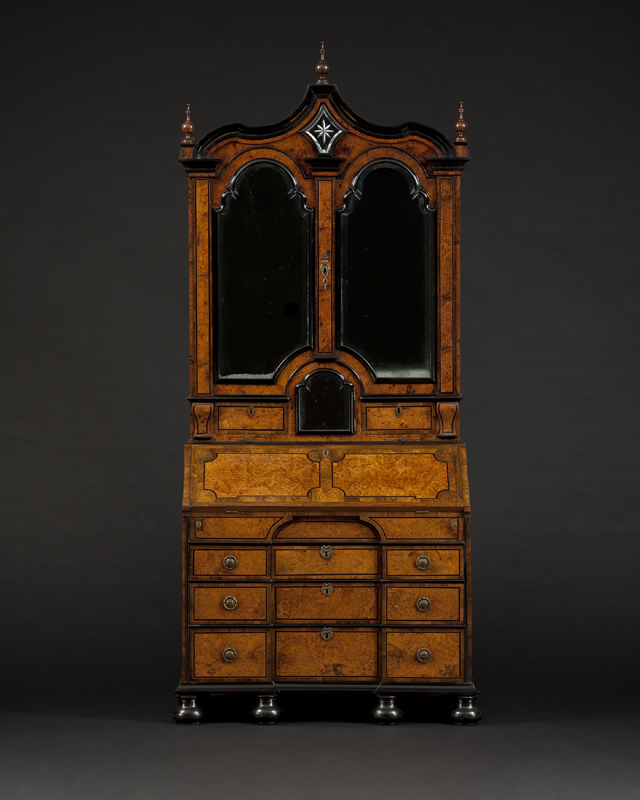
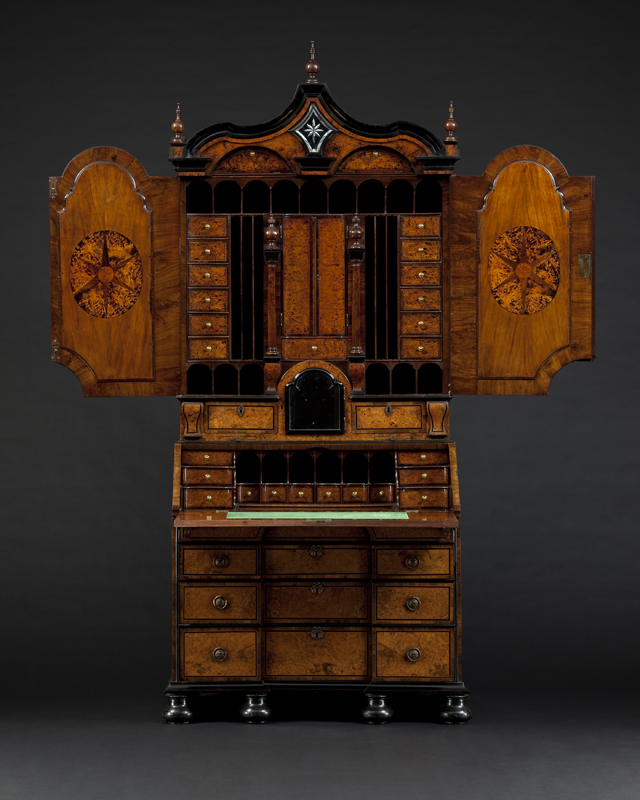
Of amboyna, ebony and kingwood. The shaped, molded ebony cornice rising to a pinnacle set with three turned finials. Below the central finial is an incurved lozenge-shaped panel containing an original engraved and beveled glass panel. The pair of domed doors containing old, but not original, conforming mirror plates, flanked and centered by protruding pilasters. The doors open to reveal a fully fitted interior with columns of drawers mounted with later brass handles and centered by a pair of central cupboard doors flanked by columnar bible boxes headed by turned finials. The midsection is centered by a domed door with an old, but later, conforming beveled plate flanked by two doors, which are in turn flanked by projecting corbels. The bureau section with inlaid fall, which opens to reveal a fitted interior, the drawers of which are mounted with later brass knobs. The fall above a frieze conceived as a well. The three long drawers of inverted breakfront pattern are set with old, but later, oval brass drop handles and escutcheons. The whole raised on six bulbous ebonized bun feet.
Provenance:
Private collection, Camarillo, California.
The design of the present bureau cabinet closely relates to another piece, now in a private collection, which is signed behind the central lower mirror panel Peter Miller Cabenet Macker in the Savoy in London the 13 June A[nn]o 1724 (figure 2). The similarities between the present piece and its signed counterpart are so exact as to suggest that both must be attributable to the same designer. However, it is interesting to note that while Miller’s signed cabinet is unequivocally English in materials and construction, the woods and mode of manufacture used on the present cabinet suggest it was almost certainly made in northwest Germany. Certain of its decorative details also support a Continental origin; it extensively features ebony moldings, rarely seen in England at this date, and its pilasters are supported by “smooth” Germanic-style inlaid corbels that are distinct from the typically English foliate carvings on the corbels of the signed example. Furthermore, the feet of the “English” Miller cabinet have a lightness of appearance, in line with other English turned-foot profiles, whilst the feet on the present piece have a “weight” more typically associated with German examples. These design elements also seem to indicate that the present model is of an earlier date than its English counterpart, which adds considerable interest to the piece and leads to some fascinating conclusions on its origin, maker and the international nature of the cabinet making industry in early eighteenth century London.
Full research report available on request.