


Research
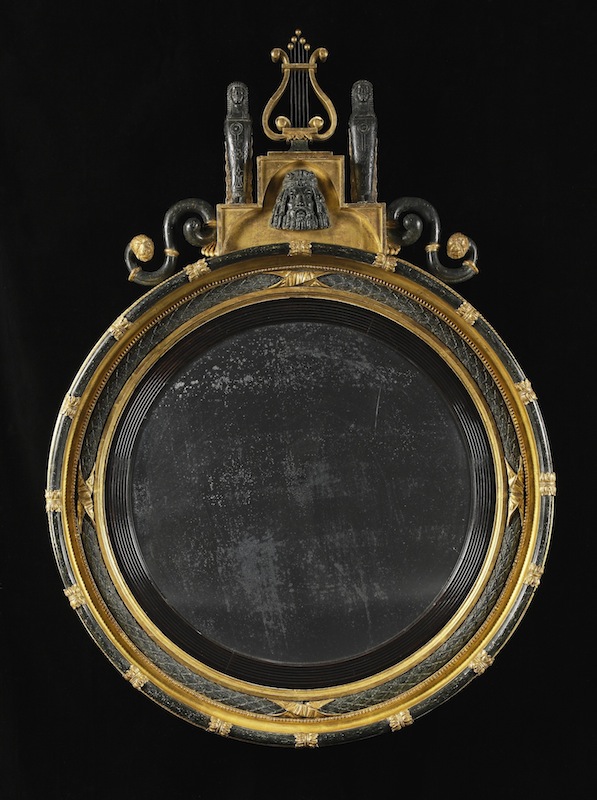
Of carved wood and composition, gilded and bronzed. The circular convex mirror plate with reeded slip bordered by a laurel wreath and circular raised frame set with stylized foliate collars flanked by pearl string borders. The top crested by a two-tiered plinth surmounted by an Egyptian figure on each side and centered by a decorative pedestal topped with a classical lyre, part of which has been recently reinstated, above a classical mask flanked by scrolled decoration terminating in a lions head. Lacking a carved section to the base. Retaining nearly all original decoration.
The present superbly carved mirror was created very much in the taste of the Anglo-Dutch banker, collector, and theorist, Thomas Hope (1769-1831). Because of the presence of the surmounting mask formed as a bearded male who wears a floral banded headdress, we are able to state that the mirror is, in all likelihood, the product of the master carver Peter Bogaert. This can be deduced by virtue of the fact that there exists an identical mask on a table from Thomas Hope’s picture gallery at Duchess Street, also in the Carlton Hobbs collection, and again on a pair of giltwood torchères in the Royal Collection. Each of the masks measures 12 cm wide by 13.5 cm high.
All three masks are drawn from a unique reverse-carved boxwood mold into which composition1 is poured, thus creating a consistently identical sculpted image. Reverse-carved molds demand the highest level of skill a carver can attain whereby he is required to create the desired subject in the negative. Peter Bogaert is one of only two craftsmen singled out for praise by Thomas Hope in his seminal work Household Furniture and Interior Decoration (1807):
I have, after the most laborious search, only been able to find two men, to whose industry and talent I could in some measure confide the execution of the more complicate [sic] and more enriched portion of my designs; namely, Decaix and Bogaert: the first a bronzist, and a native of France; the other a carver and born in the low countries.2
Recently discovered invoices from the time of his partnership with silversmith Paul Storr (from 1809) allow the attribution to Bogaert of the Royal Collection torchères and, therefore, of the other pieces bearing identical masks, i.e. the Carlton Hobbs table and the present mirror.
The design of the mirror, which draws on Egyptian, Greek and Roman iconography, is emblematic of Hope’s style and his belief that “Antiquity was to be imitated but that it was not to be copied.”3 The frame is surmounted by a plinth that recalls ancient Egyptian stepped pyramids, as well as the primordial mound, the source of life in Egyptian mythology. This form was used by Hope in Plate X of Household Furniture to support “Egyptian, Hindoo and Chinese idols and curiosities.”4 The two figures on the left and right tiers of the plinth take the form of stylized Egyptian anthropoid (human-shaped) coffins. These types of funerary caskets became standard beginning in the Second Intermediate Period (1650–1550 BC) and were decorated with a representation of the deceased, along with symbols and depictions of objects that would be of use in the afterlife. The present models are adorned with fictive hieroglyphs, though some derive from authentic ancient symbols. The topmost glyph of a circle surmounting a cross most closely resembles the Greek symbol for Venus, which also relates to the Egyptian ankh, signifying life. Each figure wears a nemes, the striped head-cloth worn by the pharaohs with two flaps hanging by the ears and shoulders, and is backed by a rippled acanthus leaf.
The cavity beneath the plinth contains the mask of a crowned and bearded male figure. The drawing for this mask can be seen in Plate XX, No. 2 of Household Furniture, which illustrates the end of table (figure 1) designed by Hope for his Picture Gallery. He executed further illustrations of the “comic and tragic masks of Silenus, of Bacchante, of Juno and of Hercules” in plate XXXVII. Hope used masks in a number of his decorative schemes, basing them on ancient comic and tragic prototypes used by Greek and Roman actors, such as those depicted in the mosaic of “Choregos and actors” found in the House of the Tragic Poet, Pompeii (figure 2). Hope also drew upon the various eighteenth-century publications whose collections of classical designs comprised such masks, including Tischbein’s Illustrations of Homer from Ancient Monuments (1801-1823) and Baron d’Hancarville’s Antiquités Étrusques, Grecques et Romaines (1766-67) which featured pieces from the vase collection of Sir William Hamilton.
Further allusions to the ancient world can be found in the carved laurel wreath of the frame, a reference to victory and the ancient Roman Empire, as well as the crown of the god Apollo. The two pearl-string borders recall Venus, the goddess of love. The scrolled lion motif on either side of the mirror crest is related to gold Cypriot spirals of the 5th century BC worn as jewelry by Grecian men and women, an example of which survives in the Metropolitan Museum (figure 3).
Thomas Hope was born in Amsterdam to a Scottish family of court and government bankers living in Holland since the 17th century. The family had amassed a significant fortune and exercised it to influence both cultural and political arenas. Thomas’ father, John Hope, was a celebrated connoisseur of art and antiquities, with an extensive collection of Dutch and Flemish works. They participated financially in “the rise and fall of empires,”5 including the expansionism of Gustavus III of Sweden and Catherine the Great of Russia, the support of Louis XVI in 1789, and the completion of the Louisiana purchase by the American Republic in 1803. Although prominent Dutch citizens, the Hopes lived according to Gallic tradition, mirroring the ancien regime, and “prided themselves on being Frenchified, spoke only French and lived entirely à la Française.”6
In 1787, at the age of eighteen, Thomas Hope embarked on his Grand Tour, which took a decade to complete and brought him to Greece, Italy, France, Spain, Germany, the Ottoman Empire and North Africa. While in Rome he enjoyed the company of fellow connoisseurs Sir William Hamilton, the Earl of Carlisle and the Earl-Bishop of Derry, as well as artists and architects such as Angelica Kauffman, Antonio Canova and Charles Heathcoate Tatham, whom Hope would later employ in England.7
Upon returning to London, Hope established himself at the corner of Mansfield Street and Duchess Street, expanding and remodeling his house between 1799 and 1802 with the help of Tatham. Determined to improve the standards of design and craftsmanship in London, the neoclassical and neo-Egyptian interiors were filled with ancient sculpture he acquired in Italy, neoclassical sculpture by contemporary artists such as Bertel Thorvaldsen and John Flaxman, a portion of Sir William Hamilton’s collection of Greek and Roman vases, as well as furniture designed by Hope himself. The house in Duchess Street “[rivaled] in splendor and originality the other ‘lions’ of Regency taste: the Prince of Wales’s London residence at Carlton House and ‘Chinese’ pavilion at Brighton; Beckford’s neo-Gothic abbey at Fonthill; and John Soane’s house in Lincoln’s Inn Fields,” with the distinction that Hope’s house was “more modern and more public.”8 Hope entertained regularly and his lavish receptions, or “routs,” were attended in large numbers by the upper echelons of Regency society, not least the Prince of Wales.
Hope’s interest and involvement in the design of his furniture was “unconventional for someone from his wealthy and cultured background.”9 The ancient Egyptian, Greek, and Roman architecture and artifacts he studied during his time abroad had a profound influence on his designs, which were published in Household Furniture. The purpose of the publication, which provided a detailed and faithful inventory of his house on Duchess Street, was to accurately record his original designs and thereby prevent any more “extravagant caricatures”10 of his style, which had “begun to start up in every corner of this capital.”11 The book had an enormous impact on contemporary fashion and certainly fulfilled its intended purpose, for in 1827 John Britton could write that it had “not only improved the taste of cabinetmakers and upholsterers, but also that of their employers.”12 Shortly after the publication of Household Furniture, Hope acquired the Deepdene, his country house in Surrey, which was furnished with equal richness in Empire-style and Egyptian-revival furnishings and imported marbles for tabletops and chimneypieces.
No records as to who made Hope’s furniture have yet come to light. In his introduction to Household Furniture he bemoans the difficulty of finding craftsmen in London with adequate abilities both in their level of skill in designing furniture and familiarity with the ancient world, and was thus compelled to take upon himself “the laborious task of composing and of designing every different article of furniture” he wanted produced.13
The present mirror is a beautifully conceived and well-informed example of the Egyptian taste during the British Regency. This vogue achieved the momentum of a mania following Nelson’s destruction of Napoleon’s fleet at Aboukir Bay in 1798. In the aftermath of Nelson’s victory, the use of such motifs became a statement of patriotism and high fashion as well as conveying the impression of learned sophistication and familiarity with the history of the ancient past.
The frame surrounds a convex mirror plate, a form of looking glass especially popular in British Regency interior design. One of the earliest and best-known depictions of a convex mirror occurs in the Arnolfini Wedding Portrait by Jan Van Eyck’s 1434 (National Gallery, London). To make a convex plate at this early date probably involved use of the blown method, an extremely skilled and costly process that made such pieces the preserve of the very wealthy. It is interesting to note that in the highly symbolic Arnolfini portrait the mirror is thought to represent the eye of God watching over the newly married couple.
It was not until the latter part of the eighteenth century that such mirror plates could be made in a mold. This more efficient, less costly approach promoted a great fashion among the elite for this type of mirror in England during the first decades of the nineteenth century. The Regency addiction to light and space led to the greatly increased use of wall mirrors, which the antiquarian John Britton (1771-1857) remarked “were adopted to extend the apparent dimensions of our rooms.”14 In 1803 Thomas Sheraton observed in his Cabinet Dictionary that “the perspective of the room in which [convex mirrors] are suspended presents itself on the surface of the mirror and produces an agreeable effect.”15
Footnotes:
- Although recipes vary, the four main ingredients of composition are oil, glue, resin and chalk. The resulting material, which has a consistency much like dough, is then pressed into a mold and is very hard and durable once dry.
- Thomas Hope, Household Furniture and Interior Decoration: Classic Style Book of the Regency Period. (New York: Dover Publications, 1971).
- David Watkin and Phillip Hewat-Jaboor, eds. Thomas Hope: Regency Designer, (New Haven and London: Yale University Press, 2008) xiii.
- Hope, 28.
- Carlton Hobbs LLC. The Thomas Hope Table: A Rediscovered Masterpiece, (New York: Carlton Hobbs LLC, 2007) 4.
- Ibid.
- Ibid. 6.
- Watkin and Jaboor, Thomas Hope: Regency Designer, 15.
- Ibid., 57.
- David Watkin, Thomas Hope and the Neo-Classical Idea, (London, 1968) 223.
- Ibid., 224
- Ibid., 4.
- Ibid., 57
- John Britton, The Union of Architecture, Sculpture, and Painting: Exemplified by a Series of Illustrations, with Descriptive Accounts of the House and Galleries of John Soane, (London: The author, 1827) 17.
- Charles F. Montgomery, ed. Thomas Sheraton’s Cabinet Dictionary, Volume II, (New York: Praeger Publishers, Inc., 1970)